
Does Polycarbonate Block UV? UV Filtering and Weather Protection Explained
Polycarbonate can filter a large share of ultraviolet radiation while still transmitting visible light, but that does not mean every polycarbonate sheet is suitable for years outdoors. UV filtering describes what passes through the panel. UV weather protection describes how the panel itself resists yellowing, haze, surface cracking and loss of impact performance. For outdoor work, buyers need to confirm both.
Short answer: does polycarbonate block UV?
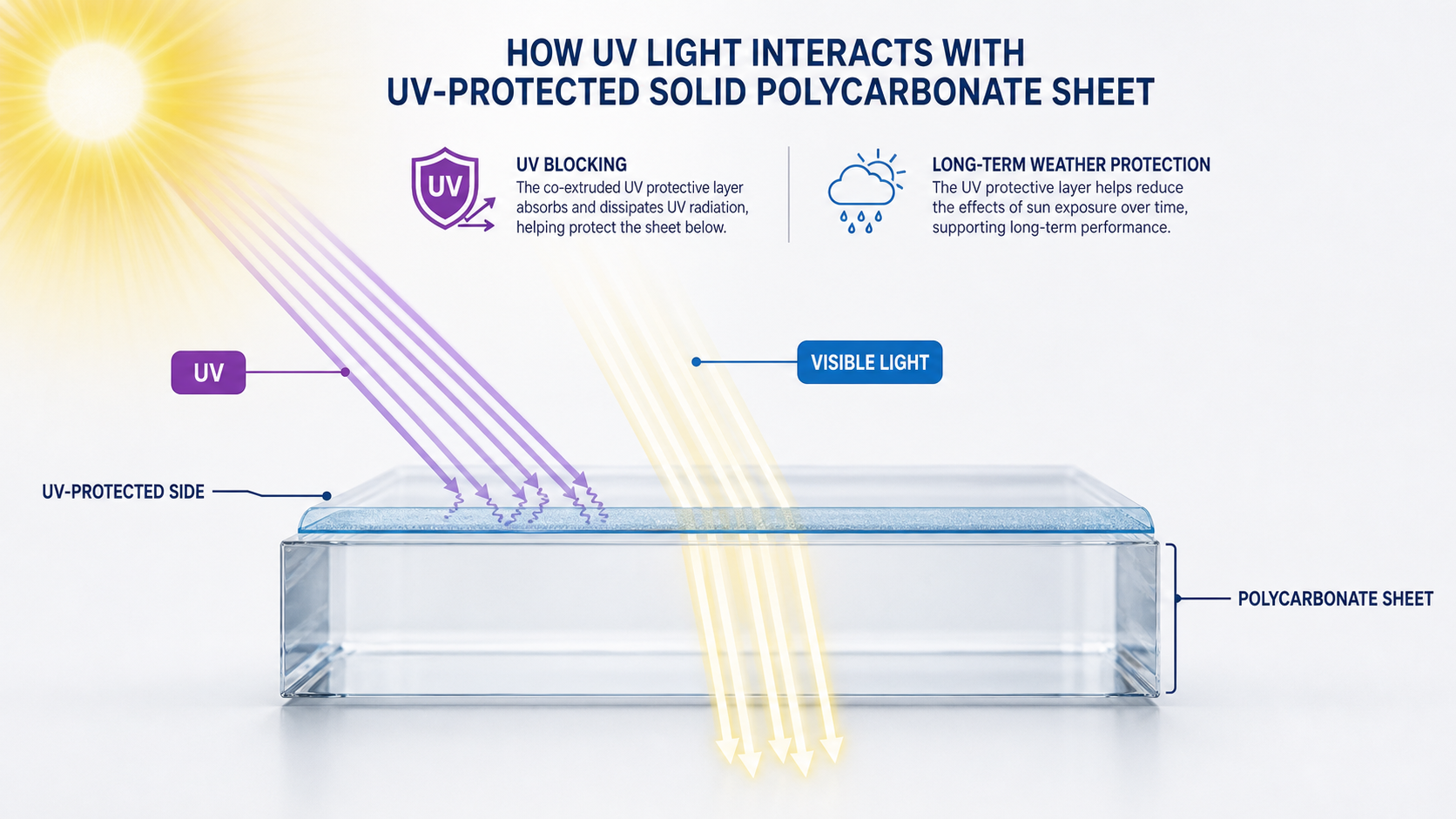
Polycarbonate absorbs ultraviolet energy, so a clear panel can reduce UV transmission without becoming opaque to visible light. The exact spectral transmission depends on resin grade, thickness, colour, additives, coating and wavelength. A statement such as “UV protected” should therefore be checked against the supplier’s spectral or product data rather than treated as a universal percentage.
There is a second issue. Absorbing UV exposes the polymer to the same energy it is stopping. Unprotected polycarbonate can weather: the surface may yellow or haze and mechanical properties may decline. Outdoor sheet is commonly stabilized in the resin, protected by a hard coat, or made with a thin co-extruded layer concentrated with UV absorber.
UV filtering is not the same as UV weather resistance
| Question | What it measures | What the buyer should request |
|---|---|---|
| Does UV pass through? | Spectral transmission through the sheet at stated wavelengths | A transmission curve or test result for the exact grade, colour and thickness |
| Will the panel yellow outdoors? | Change in yellowness, haze and light transmission after weathering | Weathering test method, exposure level and warranty conditions |
| Which side faces the sun? | Location of a one-sided co-extruded protective layer | Protective-film marking and installation instructions |
| Can both faces be exposed? | Whether UV protection is applied to one or two sides | Written confirmation of one-side or two-side protection |
This distinction is supported by manufacturer literature. Palram’s SUNLITE technical page explains that polycarbonate absorbs UV but can itself degrade, which is why many outdoor sheets carry a thin co-extruded protective layer. Covestro’s Makrolon optical-properties guide describes resin stabilization, UV-absorbing hard coats and co-extruded UV-protection layers, and evaluates weathering through changes such as yellowness and light transmission.
How the co-extruded UV side works
During sheet extrusion, a co-extrusion unit can place a thin functional layer on the surface of the base polycarbonate. The layer becomes an integral part of the sheet rather than an adhesive film added after production. Its UV absorber is concentrated near the exposed surface, where solar radiation first reaches the panel.
For a one-sided grade, the marked face must point towards the sun. Reversing the panel leaves the base sheet facing the highest exposure and defeats the intended weathering design. Some grades have protection on both faces for signs, screens, curved parts or installations where either face can receive sunlight; this must be specified rather than assumed.
What happens when the wrong sheet or wrong side faces outdoors?
Outdoor failure is not normally a single dramatic event. It develops as changes in appearance and surface condition:
- Yellowing: the panel develops a warmer colour and lower visual clarity.
- Haze: scattered light increases and a previously clear view becomes cloudy.
- Surface deterioration: prolonged exposure can contribute to fine cracking or loss of gloss.
- Property retention: weathering can reduce impact or mechanical performance even when the panel remains intact.
These outcomes depend on climate, orientation, exposure time, grade and maintenance. A warranty is useful only when it identifies the covered property, test or acceptance limit, installation conditions and exclusions.
Does a UV-protected roof stop UV needed by plants?
Greenhouse buyers often combine two different questions: whether the covering blocks ultraviolet wavelengths and whether crops still receive useful light. Photosynthetically active radiation is normally discussed in the visible 400–700 nm range, so a panel can reduce UV and still provide high visible-light transmission. Crop response also depends on diffusion, total light level, condensation control, climate and species.
For a greenhouse project, request the actual transmission data for the proposed multiwall polycarbonate sheet, not a generic statement about polycarbonate. Clear, diffused and tinted grades can produce different growing environments.
Buyer checklist for outdoor polycarbonate sheet
- State the application, location and expected service life.
- Confirm whether one face or both faces receive direct sunlight.
- Specify solid or multiwall construction, thickness, colour and dimensions.
- Ask whether protection is in the resin, a co-extruded layer, a hard coat, or a combination.
- Request spectral transmission data if UV reaching people, artwork, products or crops matters.
- Request weathering evidence if long-term clarity and impact retention matter.
- Keep the protective-film marking visible until the UV-protected side has been identified.
- Confirm cleaning chemicals and installation accessories, because incompatible products can damage polycarbonate independently of UV exposure.
What SinoPlastix can confirm before quotation
SinoPlastix Our Jiangsu production team extrudes solid and multiwall polycarbonate and can identify the UV-protection construction offered for a quoted grade. Before approval, send the application, exposed face, thickness, finished size, colour, quantity and destination. If a project has a wavelength-specific requirement, include the required range and acceptance threshold so it can be checked against applicable data rather than inferred from the words “UV protected.”
Review the available solid polycarbonate sheet, multiwall polycarbonate sheet and roofing application guidance, or send the project specification for a written quotation.
Frequently asked questions
Does clear polycarbonate block all UV?
Do not assume a universal 100% figure. Ask for spectral transmission data for the exact grade, thickness and wavelength range. “Clear” describes visible appearance, not a complete UV specification.
Is the removable protective film the UV layer?
No. The removable film protects the surface during transport and often marks the UV-protected face. The functional UV protection is part of the sheet construction; remove the transport film according to the installation instructions.
Can polycarbonate be installed with either side facing out?
Only when the supplier confirms two-sided UV protection. For one-sided sheet, the marked UV-protected face must point towards the sun.
Buying rather than researching? We manufacture in Jiangsu, China and ship worldwide – see UV protected greenhouse polycarbonate sheet, or send your specification for a quote in one working day.