
Compare the exact PC sheet construction, then ask for the installed-system result. A U-value in W/m²K describes heat transfer: lower means less heat flow under its stated calculation or test conditions. A nominal thickness such as “16 mm polycarbonate” does not identify a U-value by itself. Use named section and area-mass data to shortlist a sheet, then have the project designer assess the frame, edges and joints against the required whole-system target.
Request a thermal sheet shortlist Still selecting thickness?
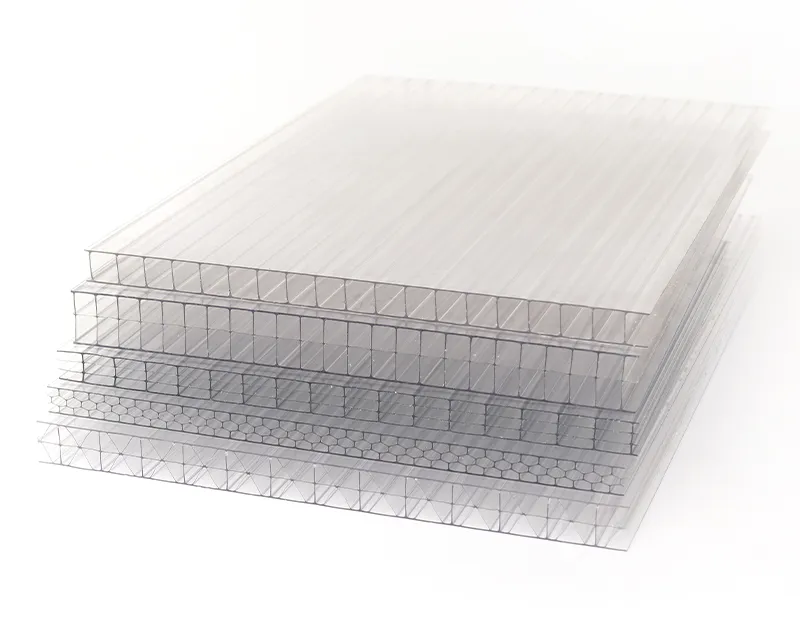
Three named examples, not a universal SinoPlastix chart
The datasheets below are Brett Martin products and illustrate how real product data should be compared. Their values are not SinoPlastix sheet test results or an installed roof/window U-value. The brief datasheet tables do not state the U-value method or boundary conditions, so confirm these before using a number in an energy model.
| Named reference construction | Depth and area mass | Published sheet U-value | Published clear light transmission | What to notice |
|---|---|---|---|---|
| Marlon ST 10 mm twinwall | 10 mm; 1.7 kg/m² | 3.20 W/m²K | 82% | A lighter, thinner named construction; use its own optical and structural data. |
| Marlon ST 16 mm triplewall | 16 mm; 2.7 kg/m² | 2.40 W/m²K | 77% | Same nominal depth and mass as the next row, but a different internal section. |
| Marlon ST 16 mm fivewall | 16 mm; 2.7 kg/m² | 1.90 W/m²K | 69% | Lower published sheet U-value, with lower published clear transmission than the triplewall example. |
These source files are dated 2022–2023 and may change. Their light-transmission entries are for each named product’s clear option; do not use them to predict a coloured, coated or otherwise different sheet. No row establishes an allowable span or condensation performance.
Solid polycarbonate sheet: calculated U-value and R-value
Solid PC has no air chambers, so its sheet U-value stays close to that of single glazing and changes little with thickness: going from 4 mm to 10 mm lowers it by only about 13%, because the air films on each face do most of the insulating. The values below are calculated, not tested: U = 1 / (Rsi + Rse + d/λ), with λ = 0.21 W/mK for solid polycarbonate (ASTM C177, Palram PALSUN published data) and the EN ISO 6946 conventional surface resistances Rsi = 0.13 m²K/W for vertical glazing or 0.10 m²K/W for a roof with upward heat flow, and Rse = 0.04 m²K/W.
| Solid PC thickness | U-value, vertical glazing | U-value, roof (heat flow up) | R-value (SI), vertical | R-value (US, ft²·°F·h/Btu), vertical |
|---|---|---|---|---|
| 2 mm | 5.6 W/m²K | 6.7 W/m²K | 0.18 m²K/W | 1.0 |
| 3 mm | 5.4 W/m²K | 6.5 W/m²K | 0.18 m²K/W | 1.1 |
| 4 mm | 5.3 W/m²K | 6.3 W/m²K | 0.19 m²K/W | 1.1 |
| 5 mm | 5.2 W/m²K | 6.1 W/m²K | 0.19 m²K/W | 1.1 |
| 6 mm | 5.0 W/m²K | 5.9 W/m²K | 0.20 m²K/W | 1.1 |
| 8 mm | 4.8 W/m²K | 5.6 W/m²K | 0.21 m²K/W | 1.2 |
| 10 mm | 4.6 W/m²K | 5.3 W/m²K | 0.22 m²K/W | 1.2 |
| 12 mm | 4.4 W/m²K | 5.1 W/m²K | 0.23 m²K/W | 1.3 |
Sheet-only planning values, not SinoPlastix test results and not an installed window or roof U-value. Wind, frames, edges and joints change the system result. US R-value = SI R-value × 5.678. If you need lower heat loss than solid sheet can give, compare the multiwall constructions above.
Sheet U-value is not the roof or window U-value
Named wall structure, thickness and area mass
Bars, gaskets, metal paths and supported area
Closures, seals, leakage and installation condition
The project thermal result combines these parts according to the applicable method and geometry. A published sheet U-value cannot simply be copied into a whole-roof, skylight or facade compliance submission. Ask whether a quoted number is calculated or measured, which standard and conditions were used, and whether it describes the sheet or complete installed unit.
Choose the right comparison for your project
- Start with the target. Give the required whole-system U-value or energy-code criterion, site and indoor/outdoor design conditions.
- Keep daylight in the decision. Specify a minimum visible light transmission and preferred clear, opal or tinted appearance; more cells can affect both thermal and optical results.
- Request two or three actual constructions. SinoPlastix can quote custom PC sheet options with the named wall section, thickness, area mass, UV side, colour and dimensions. Ask sales for the applicable original reports or datasheets for the offered grade.
- Confirm the system calculation. The designer should include frame fraction, glazing bars, edge treatment, condensation and local code method. If roof support is also critical, use the load/span guide separately.
Copy a thermal brief into your RFQ
Fill what you know, then copy these lines into the RFQ message. The written quotation will identify the offered PC construction, actual price, lead time and applicable technical documents.
Send the thermal project brief See SinoPlastix multiwall PC
Questions buyers ask
Does every 16 mm multiwall PC sheet have the same U-value?
No. Wall count, rib geometry, area mass and grade matter. Compare the actual named construction and the method behind its published sheet U-value.
Can I use a sheet U-value for a whole skylight?
No. The installed unit also includes frames, bars, seals and joints. Ask the project designer for a whole-system calculation or test under the governing method.
Does a lower U-value always mean the better sheet?
Not by itself. Compare the project thermal target with daylight, colour, load support, condensation, budget and fabrication requirements before choosing the quoted PC construction.