
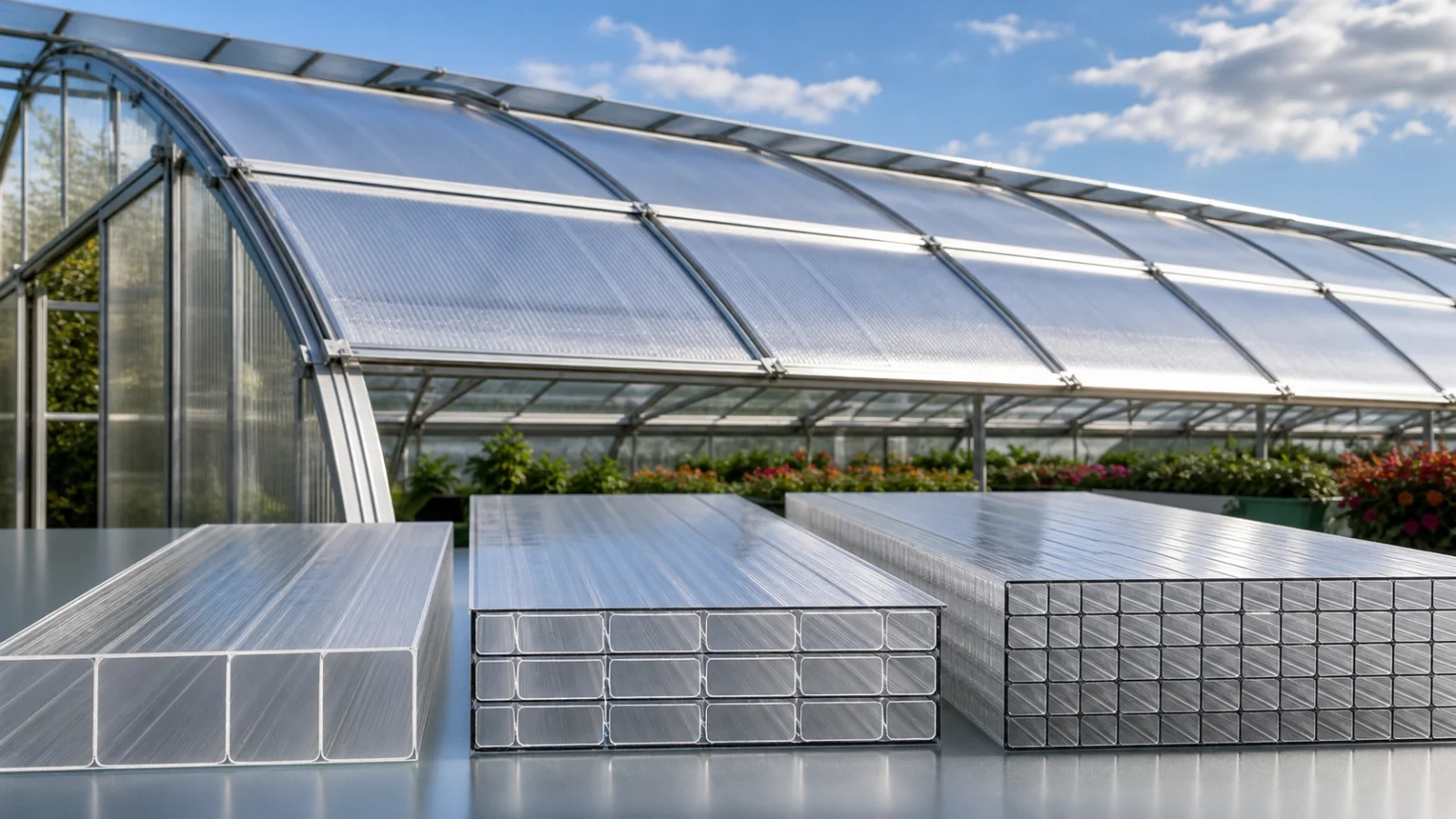
Twin-wall is one member of the multiwall polycarbonate family. It has two outer skins joined by ribs, forming a row of hollow cells. “Multiwall” also covers triple-wall and more complex X or honeycomb sections. If you are comparing roof or greenhouse panels, the useful question is not simply how many walls a sheet has: it is which named section fits your frame, load, daylight and insulation targets.
What each structure name actually tells you
| Name on a quote | Cross-section meaning | Still unknown from the name alone |
|---|---|---|
| Twin-wall | Two outer skins and one tier of cells between them. | Rib spacing, sheet mass, UV treatment, load capacity and light transmission. |
| Triple-wall | Three skins with two cell tiers. | Chamber geometry, weight and whether the thermal or span figures use the same test basis. |
| X / honeycomb | Diagonal or denser internal webs; these names are not a universal wall count. | The actual section drawing, joining system and tested performance. |
An “8 mm twin-wall” label still does not define a single profile: two nominally 8 mm panels can have different rib pitch and weight per square metre. Ask for the named section and its own data sheet before treating quotes as equivalent. The multiwall product page covers available structure families and the full ordering brief.
Read a section drawing before reading a span claim
- Count skins and cell tiers: a marketing name can cover more than one rib pattern. Check the actual end view for the panel in the quote.
- Check the units: nominal thickness is in mm; sheet mass is usually given in kg/m² or g/m². Compare like for like rather than assuming the same thickness means the same amount of material.
- Match the performance sheet: light transmission is normally a percentage; thermal transmittance is expressed as a U-value in W/m²·K. Confirm colour, thickness, method and named panel before comparing figures.
- Read the load-table conditions: a span in mm only means something with the stated support spacing, load in kPa, panel orientation, edge engagement and deflection criterion. A project designer must confirm the installed system.
More walls do not automatically mean a better panel for every roof. A denser section may also change daylight appearance, weight and profile fit. For roofing, the channel and UV-face orientation, drainage and end closures belong to the installed system; use the selected system’s instructions rather than a generic “twin-wall” rule.
From explanation to a named product
If a quote only says “10 mm twin-wall,” ask for the exact cross-section drawing, mass per m², optical/thermal figures and the applicable load table. Compare those documents against your frame and local design requirements. SinoPlastix can provide a sample of the proposed section and, on request, common test-report originals for the relevant grade and scope. The multiwall product page lists the structure and application choices and tells you what to send for a quotation.
See multiwall PC product options Ask about a named section
Questions buyers ask
Is twin-wall the same as multiwall?
Twin-wall is one type of multiwall panel with two outer skins and one row of cells. Multiwall is the broader category, including other rib and cell layouts.
Does more wall count always mean better insulation?
No. Compare the named panel’s thickness, cell geometry, weight and thermal test basis. Also check the light appearance and support requirements for your project.
Which direction should the ribs run?
For roofing, channels commonly run down the slope so condensation can drain, subject to the selected system’s installation guide. Specify the direction on your drawing.
Technical references
For examples of why section geometry, load tables and installation details must be read together, consult the manufacturers’ Plaskolite POLYGAL fabrication guide and Palram SUNLITE product information. Their published values apply to their own named products; use the current data for the panel in your quotation.